A well-maintained Lincoln Aviator can realistically target about 200,000 to 250,000+ km of useful life, with condition and service history mattering more than mileage alone. Buyers should inspect more carefully after 110,000 km, and especially after 150,000 km, because powertrain, AWD, suspension, brakes, tires, and luxury electronics become more important.
Best for: Buyers who want a luxury three-row SUV and want a more specific kilometre-based answer before buying.
For Fort McMurray drivers, Lincoln Aviator life expectancy depends on more than the odometer. Cold starts, winter roads, highway kilometres, family driving, and longer trips outside the city can all affect how a luxury SUV ages. The Aviator uses a 3.0L twin-turbo V6 with 400 horsepower and 415 lb-ft of torque, so regular maintenance and inspection history matter for long-term confidence.
| Kilometre Range | What It Usually Means | What Buyers Should Check |
|---|---|---|
| Under 80,000 km | Lower-kilometre range and still within the basic warranty distance if the vehicle age also qualifies. | Confirm warranty start date, service records, tires, brakes, and all comfort features. |
| 80,000 to 110,000 km | Past basic warranty distance, but potentially within powertrain warranty distance if the age limit also qualifies. | Check engine performance, transmission feel, AWD operation, suspension, and repair history. |
| 110,000 to 150,000 km | More inspection-sensitive range where maintenance history becomes much more important. | Review fluid service, brake work, battery condition, tire replacement, and completed repairs. |
| 150,000 to 200,000 km | Higher-kilometre range where condition matters more than trim level or appearance. | Inspect turbo engine response, 10-speed transmission feel, AWD, suspension, electronics, and warning lights. |
| 200,000 to 250,000+ km | Realistic long-life range for a properly maintained Aviator, but not something to assume without proof. | Only consider if records are strong, inspection results are clean, and repair costs fit your budget. |
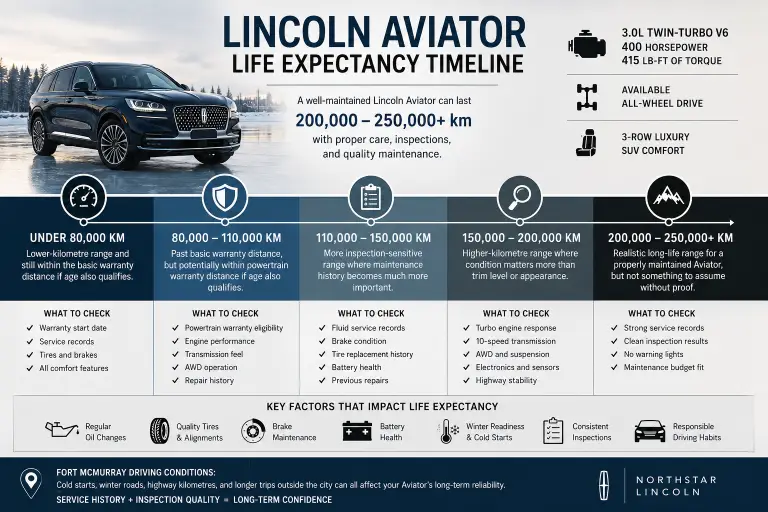
The longest life usually comes from owners who keep up with maintenance instead of waiting for problems to appear. Oil service, inspections, tire care, brake work, battery condition, fluid checks, and repair records all matter.
The Aviator is not a basic commuter SUV. It is a luxury three-row SUV with a powerful twin-turbo engine, advanced technology, comfort features, and available all-wheel drive. That means a buyer should look beyond mileage and ask how the vehicle was used, maintained, stored, repaired, and inspected.
The biggest factors are service history, powertrain care, winter use, tire quality, brake condition, and electronics. A Lincoln Aviator with higher kilometres and strong records can be a better long-term choice than a lower-kilometre one with unclear history.
Specific items to check include the 3.0L twin-turbo V6, 10-speed automatic transmission, available AWD system, suspension, brakes, tires, infotainment, cameras, heated features, power seats, liftgate, and driver-assist features. These are the systems that affect both reliability confidence and ownership cost as the vehicle ages.
Mileage starts to matter more once a Lincoln Aviator is past 110,000 km, because that is a useful benchmark for when many buyers begin looking more closely at long-term powertrain condition, repair history, and inspection results. It does not mean the SUV is worn out, but it does mean service records become much more important.
After about 150,000 km, the inspection should be more detailed. Buyers should pay close attention to the 3.0L twin-turbo V6, 10-speed automatic transmission, available AWD system, suspension feel, brake condition, tire wear, battery health, and luxury electronics. A clean, well-maintained Aviator at 150,000 km can still be a better choice than a lower-kilometre one with poor records.
Fort McMurray driving can make winter readiness a bigger part of life expectancy. Cold starts, snow, slush, gravel, rougher roads, and highway driving can affect batteries, tires, brakes, suspension parts, fluids, and underbody condition over time.
That does not make the Aviator a poor fit. It simply means local buyers should inspect it based on real driving needs. A strong Fort McMurray Aviator should heat properly, defrost quickly, start confidently, ride smoothly, brake cleanly, and feel stable during a test drive.
A Lincoln Aviator does not have one official life expectancy number that applies to every vehicle. A better real-world target is 200,000 to 250,000+ km for a well-maintained example, but that depends heavily on the condition of the specific SUV.
For example, an Aviator with 90,000 km and poor maintenance history may be riskier than one with 130,000 km and strong service records. The better buy is usually the one with cleaner documentation, better inspection results, smoother road feel, and fewer unresolved issues.
Start with the records. Look for regular oil changes, documented inspections, tire replacement, brake service, completed repairs, and no ignored warning lights. Then test the SUV in person.
During the test drive, check startup, idle quality, acceleration, braking, steering, shifting, suspension feel, highway stability, climate controls, cameras, sensors, and infotainment. A Lincoln Aviator with plenty of life left should feel quiet, smooth, strong, and consistent.
Under 80,000 km: Confirm warranty start date, ownership history, tire condition, brake feel, and feature operation.
80,000 to 110,000 km: Review powertrain coverage eligibility, engine response, transmission smoothness, AWD operation, and service history.
110,000 to 150,000 km: Look more closely at fluids, brakes, tires, battery health, suspension feel, and previous repairs.
150,000 to 200,000 km: Treat inspection quality as more important than trim level. Test electronics, cameras, sensors, climate controls, heated features, steering, braking, and highway stability.
200,000 km and above: This can still be a possible long-life range, but only with strong records, clean inspection results, and realistic expectations for luxury SUV maintenance.
If you are comparing long-term Aviator ownership, focus on mileage, service records, powertrain condition, winter readiness, and inspection results.
You may also want to read whether Lincoln Aviators hold their value before deciding how long you plan to own one.
When you are ready to compare real options, browse Lincoln Aviator inventory in Fort McMurray.
Fill in the form below and our team will be in touch shortly.
🔒 Your information is encrypted and will never be shared or sold.
A well-maintained Lincoln Aviator can realistically target about 200,000 to 250,000+ km, but service history and condition matter more than mileage alone.
150,000 km is a higher inspection point, not an automatic reason to avoid the SUV. Buyers should check service records, transmission feel, AWD operation, tires, brakes, and electronics.
200,000 km is not automatically too much, but it requires stronger proof. Look for clean records, a smooth test drive, no warning lights, and a proper inspection.
Be more careful after 110,000 km and especially after 150,000 km. At those ranges, maintenance history and inspection results become more important.
Regular oil service, timely repairs, quality tires, brake maintenance, fluid checks, winter care, and quick attention to warning lights all help long-term ownership confidence.
No. A lower-kilometre Aviator with poor records can be riskier than a higher-kilometre one with strong service history and clean inspection results.