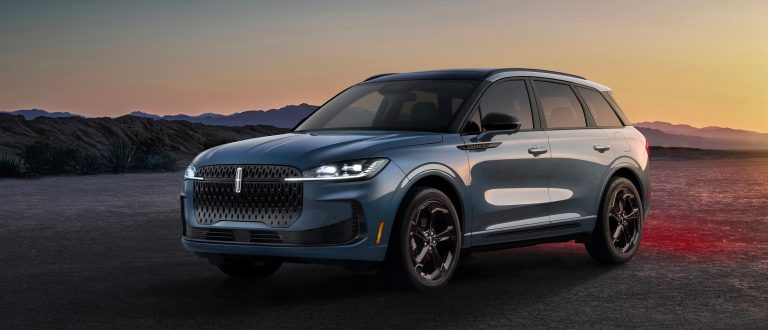
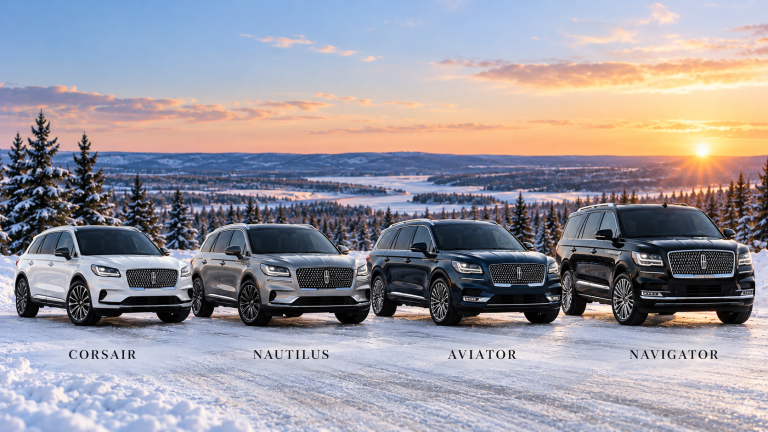
The Lincoln Aviator is the better choice if you want a three-row Lincoln luxury SUV with 400 horsepower, 415 lb.-ft. of torque, seating for up to 7, and up to 5,000 lbs. / 2,268 kg of towing when properly equipped. The Lincoln Nautilus is the better choice if you want a two-row luxury SUV with seating for 5, available hybrid power, and a 7.7 L/100 km combined fuel consumption rating with the HEV powertrain.
Lincoln Aviator vs Lincoln Nautilus Specs
Specs reflect the current model year lineup and are subject to change. Confirm exact ratings for the specific vehicle you’re considering.
Lincoln Aviator vs Lincoln Nautilus Spec Comparison
A side-by-side look at the key numbers Fort McMurray luxury SUV shoppers should compare.
| Category | Lincoln Aviator | Lincoln Nautilus |
|---|---|---|
| Vehicle layout | 3-row midsize luxury SUV | 2-row midsize luxury SUV |
| Maximum seating | 7 passengers | 5 passengers |
| Available trims | Premiere, Reserve | Premiere, Reserve, Black Label |
| Standard engine | Twin-Turbocharged 3.0L V6 | Turbocharged 2.0L I-4 |
| Hybrid engine | Twin-Turbocharged 3.0L V6 | Turbocharged 2.0L I-4 HEV |
| Horsepower | 400 hp @ 5,500 rpm | 250 hp @ 5,500 rpm / 310 total system hp with HEV |
| Torque | 415 lb.-ft. @ 3,000 rpm | 280 lb.-ft. @ 3,000 rpm / 295 lb.-ft. @ 3,250 rpm with HEV |
| Transmission | 10-speed SelectShift automatic | 8-speed automatic / CVT automatic with power-split electric |
| Drive system | AWD | AWD |
| Maximum towing | 5,000 lbs. / 2,268 kg with Class III Trailer Tow Package | 1,750 lbs. / 794 kg with Class I Trailer Tow Package |
| Maximum tongue load | 500 lbs. / 227 kg | 175 lbs. / 79 kg |
| Fuel consumption | 13.8 / 9.5 / 11.9 L/100 km city/highway/combined | 9.8 L/100 km combined gas / 7.7 L/100 km combined HEV |
| Cargo behind first row | 2,149 L | 2,020 L |
| Cargo behind second row | 1,130 L | 1,030 L |
Engine and Powertrain Differences
The Lincoln Aviator keeps its powertrain choice focused. Its Twin-Turbocharged 3.0L V6 produces 400 horsepower and 415 lb.-ft. of torque, paired with a 10-speed SelectShift automatic transmission and AWD.
The Lincoln Nautilus gives shoppers two powertrain routes. The Turbocharged 2.0L I-4 produces 250 horsepower and 280 lb.-ft. of torque, while the Turbocharged 2.0L I-4 with HEV produces 310 total system horsepower and 295 lb.-ft. of torque.
For Fort McMurray drivers, the powertrain decision comes down to how the SUV will be used during a normal week. The Aviator is the stronger fit for drivers who want V6 output and three-row utility, while the Nautilus HEV is the better fit for shoppers focused on two-row comfort and lower combined fuel consumption.
Capability Numbers Explained
The Aviator has the clear towing advantage in this comparison. With the Class III Trailer Tow Package, it is rated up to 5,000 lbs. / 2,268 kg of maximum towing and 500 lbs. / 227 kg of maximum tongue load when properly equipped.
The Nautilus is rated up to 1,750 lbs. / 794 kg of maximum towing with the Class I Trailer Tow Package. Both the gas and HEV Nautilus powertrains are listed with the same 1,750-lb. maximum towing rating.
That difference matters for northern Alberta ownership. If you tow a small utility trailer, carry seasonal gear to the lake, or need more confidence for longer Alberta highway trips with passengers and cargo, the Aviator belongs higher on the list. If towing is not part of your regular routine, the Nautilus gives you Lincoln comfort without buying more towing capacity than you need.
Configuration Differences
The Aviator is a three-row midsize luxury SUV with seating for up to 7. It is available in Premiere and Reserve trims, and the second row can be configured with dual captain’s chairs or an available second-row bench.
The Nautilus is a two-row midsize luxury SUV with seating for 5. It is available in Premiere, Reserve, and Black Label trims, with AWD across the lineup and a choice between gas and HEV power.
The configuration difference changes the shopping process. Aviator buyers should focus on second-row layout, third-row use, towing package availability, and family cargo needs. Nautilus buyers should focus on gas versus HEV, trim level, wheel size, cabin features, and whether five-passenger seating is enough.
Cost of Ownership
The Lincoln Nautilus has a lower-commitment ownership profile because it uses a smaller two-row layout and offers an HEV powertrain with a 7.7 L/100 km combined fuel consumption rating. For Fort McMurray drivers with frequent commutes, repeated errands, and highway driving between communities, that efficiency advantage is meaningful over time.
The Lincoln Aviator brings more engine output, more seating capacity, and a higher towing rating. Those advantages come with the ownership demands of a larger three-row luxury SUV, including higher fuel use, larger vehicle components, and more capacity-focused equipment.
The right value depends on actual use. If the third row will sit empty most weeks, the Nautilus is the more sensible Lincoln SUV. If your household regularly carries six or seven people, takes longer road trips, or needs a properly equipped towing setup, the Aviator’s extra capacity is easier to justify.
Who Should Actually Buy the Lincoln Aviator?
Choose the Lincoln Aviator if you want a three-row Lincoln luxury SUV with AWD, a Twin-Turbocharged 3.0L V6, 400 horsepower, and a 5,000-lb. / 2,268-kg maximum towing rating when properly equipped. It fits shoppers who need more than five seats or want a luxury SUV that can handle family travel with more cargo flexibility.
The Aviator also makes sense for Fort McMurray families who drive longer distances across Alberta with passengers, winter clothing, luggage, and weekend equipment. Its combination of three rows, V6 output, and Class III towing capability gives it a broader job description than the Nautilus.
Who Should Actually Buy the Lincoln Nautilus?
Choose the Lincoln Nautilus if you want a two-row Lincoln luxury SUV with seating for 5, AWD, available hybrid power, and 2,020 L of cargo volume behind the first row. It is a strong fit for shoppers who want a premium daily SUV without needing a third row.
The Nautilus HEV is especially practical for drivers focused on fuel consumption. Its 7.7 L/100 km combined rating gives it the efficiency advantage in this comparison, while still offering 310 total system horsepower.
Frequently Asked Questions
Does the Lincoln Aviator or Lincoln Nautilus have more seating?
The Lincoln Aviator has more seating, with up to 7 passengers across three rows. The Lincoln Nautilus seats 5 passengers across two rows.
Which Lincoln SUV has more horsepower?
The Lincoln Aviator has more horsepower, with its Twin-Turbocharged 3.0L V6 rated at 400 horsepower. The Lincoln Nautilus is rated at 250 horsepower with the gas engine or 310 total system horsepower with the HEV powertrain.
Which SUV is better for towing in Canada?
The Lincoln Aviator is better for towing by the numbers. It is rated up to 5,000 lbs. / 2,268 kg when properly equipped with the Class III Trailer Tow Package, while the Lincoln Nautilus is rated up to 1,750 lbs. / 794 kg with the Class I Trailer Tow Package.
Which SUV has the better fuel consumption rating?
The Lincoln Nautilus HEV has the better listed combined fuel consumption rating at 7.7 L/100 km. The standard Nautilus gas engine is listed at 9.8 L/100 km combined, while the Aviator is listed at 11.9 L/100 km combined.
Should Fort McMurray shoppers choose the Aviator or Nautilus?
Choose the Aviator if your routine includes three-row seating, heavier cargo days, longer family trips, or towing. Choose the Nautilus if five seats, available hybrid efficiency, and easier two-row luxury cover your everyday driving needs.
For North Star Lincoln shoppers in Fort McMurray, the Aviator vs Nautilus decision should start with seating and towing, then move into fuel use, trim content, and test-drive feel. Compare both in person if you are unsure whether a two-row SUV is enough or a three-row SUV better matches your driving routine in northern Alberta.